It’s 07:00. The new shift begins, and the production plan is set: each line knows which parts it will make. At 09:13, one machine starts running too hot. Soon, parts from that line fail inspection and are scrapped. Every rejected part wastes material, energy and the time already invested in production. If the team cannot pinpoint the cause, the line may keep producing rejects, or stop while they investigate.
AI can help detect defects, anticipate machine failures and identify opportunities to reduce energy use. But an alert that a machine is running hot does not tell an operator which product is affected, why quality is falling or what to do next. To make a useful decision, the operator needs the temperature change connected to what the line is producing and the quality results coming off it.
From signals to factory intelligence
Our research focused on factory-floor production: planning what to make, carrying it out, and keeping track of process performance and quality.
The information needed to connect those decisions is spread across factory systems. Sensors and machine controllers record measurements such as temperature and speed. SCADA software displays operating conditions, and historian systems store measurements over time. Manufacturing execution systems (MES) and enterprise resource planning systems (ERP) add context such as orders, materials, inventory and capacity.
These systems do not always speak the same language. Legacy equipment, data silos and incompatible interfaces make it harder to connect their information: machine data may arrive quickly but not identify the product or order involved, while business systems add context but may be less up to date. Different identifiers, formats and timing can leave the temperature change and failed inspection as separate clues.
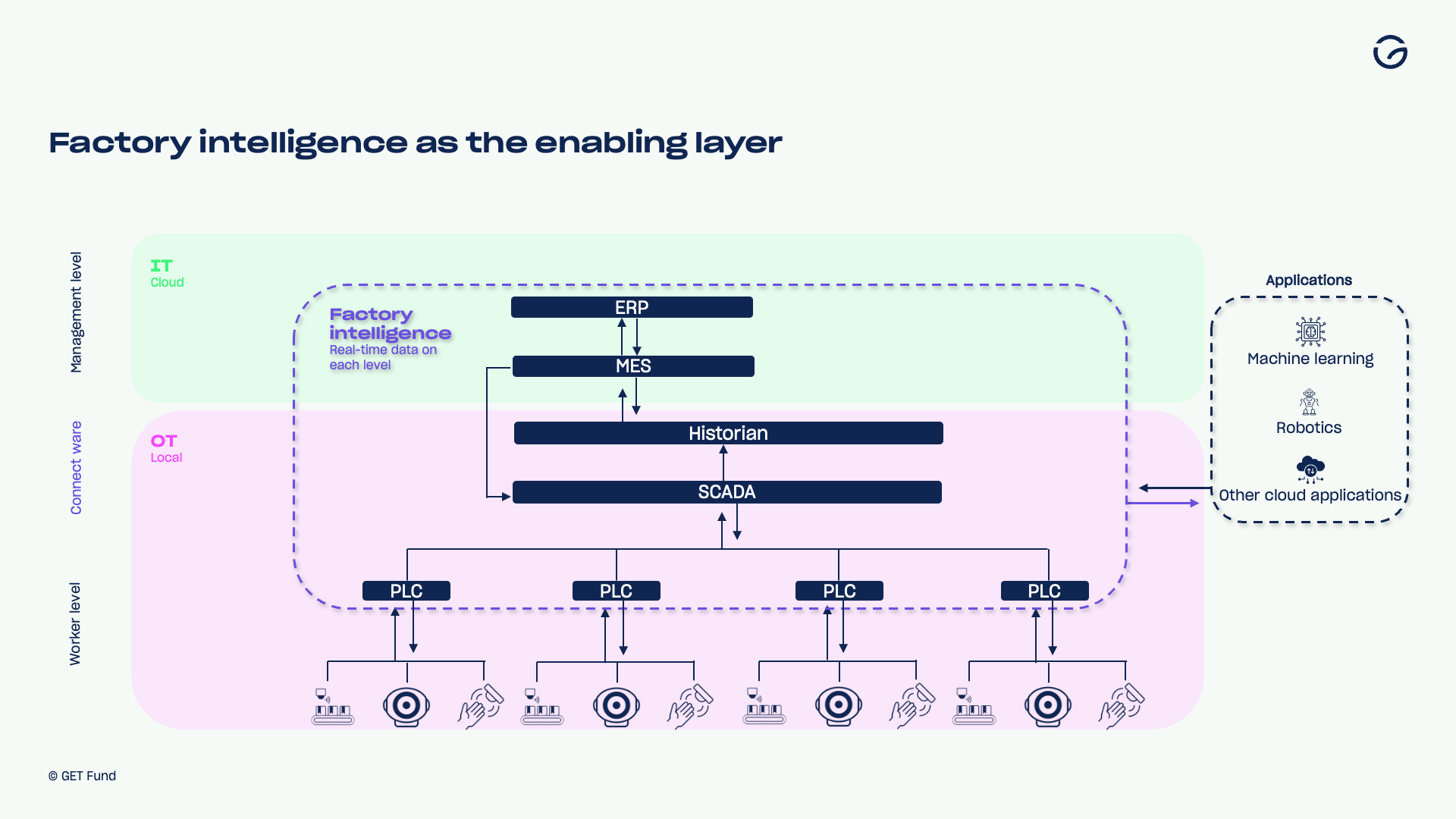
Industry 4.0 is about connecting operational technology on the factory floor (sensors, controllers and SCADA) with production and business systems such as MES and ERP. When those links reliably connect machine signals to products, orders and quality results, they create factory intelligence: the context applications need to interpret signals and support useful decisions.
Why the foundation is still uneven
Factories start from different places. Some have abundant, well-organized data; others rely on older machines that do not share data in real time, limited records or information held in separate systems. Machines and software may record the same process in different ways, leaving data incomplete or inconsistent. The lack of standardization across systems turns connectivity into a time-consuming and expensive integration effort. Every plant might require bespoke work, limiting scalable rollouts across factories and sites.
The challenge is human as well as technical. Some process knowledge sits with operators and engineers rather than in digital systems. Teams may lack the skills to use new tools or be reluctant to change established routines. Recommendations need to be reliable, traceable and easy to understand, and they must fit the way people work. Security and regulatory requirements matter too, especially when software begins to influence production decisions.
From connected systems to factory-floor decisions
That gap between connected-factory ambition and day-to-day production reality matters now. Manufacturers face pressure to protect margins, address skills shortages, use less energy and material, and keep operations resilient. In 2025, around 17% of EU manufacturing enterprises used at least one AI technology in a business process, with adoption varying across countries and company sizes. This shows that AI use is growing but does not tell us how often it is being used to guide decisions on the factory floor.
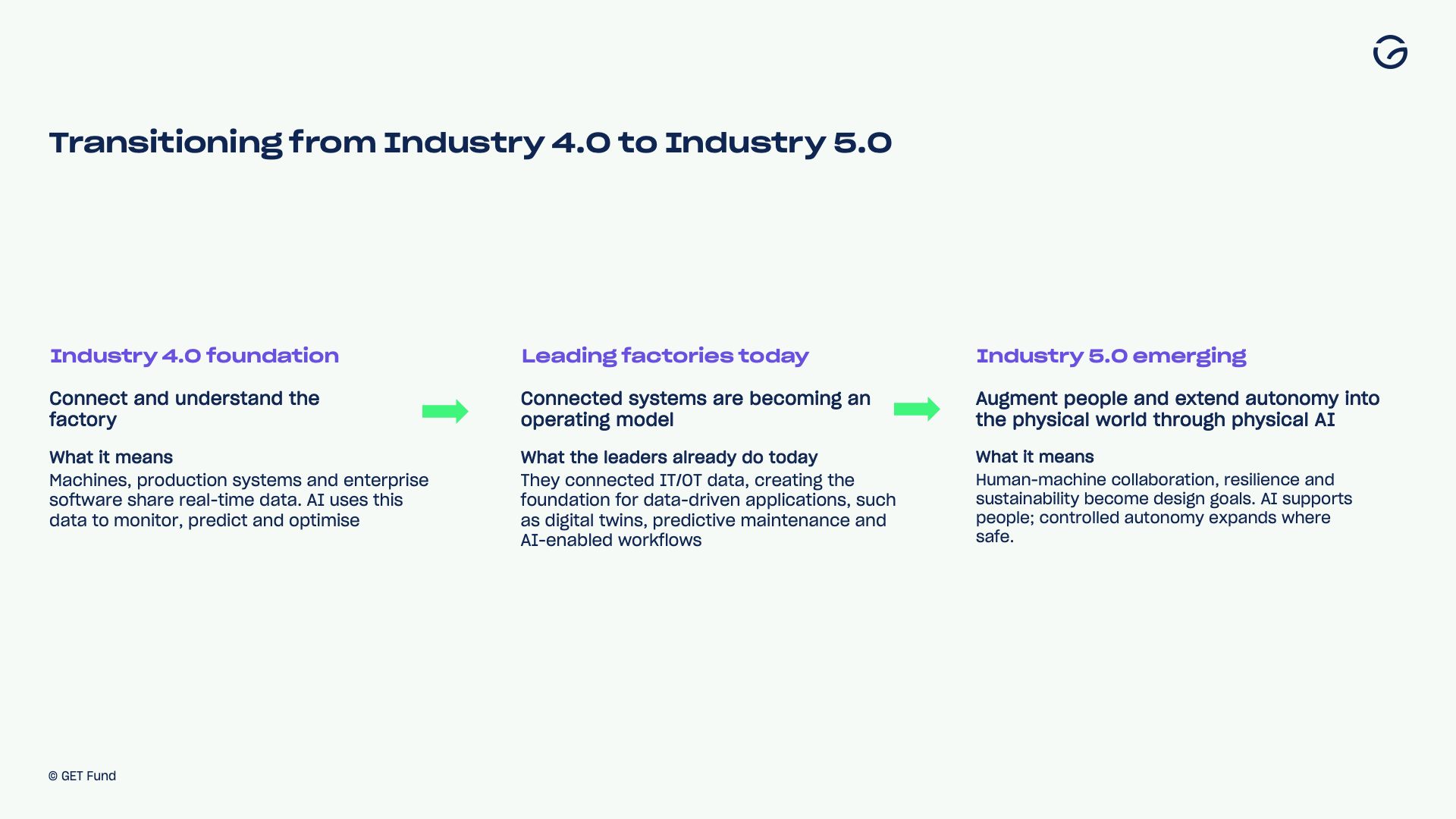
Factory intelligence is enabled by a connected data foundation. Industry 4.0 turns fragmented, raw data into contextualized, real-time input. Industry 5.0 turns that input into actionable decisions on the factory floor. The next wave of industrial AI solutions use factory intelligence to support worker’s decisions, improve resource efficiency and strengthen resilience, with autonomy where it is safe and appropriate.
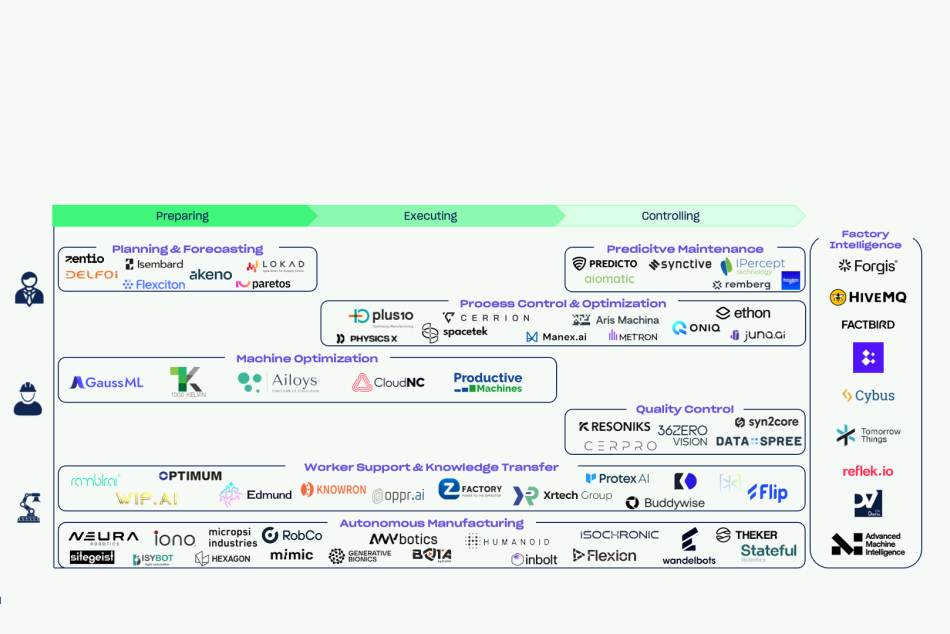
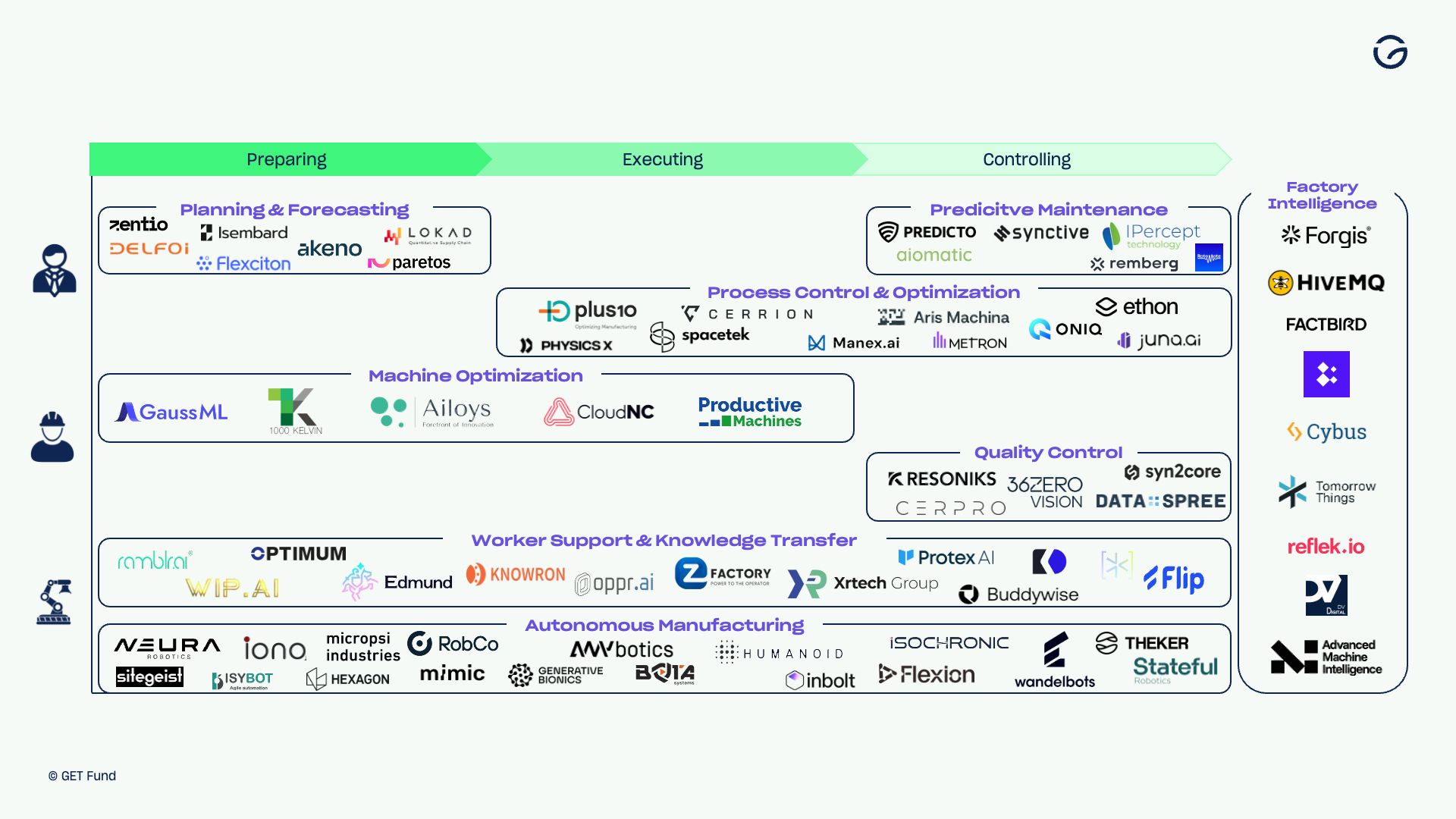
That opportunity spans the production chain, from planning and execution to process and quality control. This is how we see the market today: a broad, overlapping landscape, with many solutions spanning multiple stages and factory intelligence as the enabling layer connecting data, decisions and physical processes. As data quality, integration depth and factory conditions differ by site, no single category is an obvious winner. Autonomous manufacturing, from robotics software to humanoid platforms, is part of the wider landscape but a more capital-intensive opportunity that deserves a separate analysis.
GET Fund investment focus
At GET Fund, we see an opportunity in applications that bring AI into factory-floor decisions. They close the context-to-action gap by connecting reliable factory data to production context and turning that context into trusted decisions or actions.
Our selection is guided by the Triple Top Line: we look for solutions that improve production performance, reduce scrap and increase productivity and safety of factory workers.
This sits within our broader focus on scalable European technology with environmental and social impact, including Industrial Tech. Where it strengthens the product, we prefer solutions that combine software with relevant hardware or integrate closely with existing equipment and workflows. The aim is not hardware for its own sake, but a product that fits into existing production lines and workflows, creates operational value and can be deployed repeatedly across plants.
We look for products and business models that can scale beyond bespoke integration. A standardized core, reusable connectors, data models and workflows should make each deployment easier to configure and install. Hardware integration and embedding in physical processes can strengthen a product’s position, but defensibility also comes from operator trust and process knowledge captured and transferred through the workflow. Early implementation support may be needed; rebuilding the product for every plant should not be the long-term model.
Factory intelligence can be essential to an application, but connecting data is not an outcome in itself. Data must be reliable, traceable and auditable; its value depends on what a factory can do with that context. That is why a standalone data layer is not our primary investment focus: lower scrap, energy use or downtime come from the applications built on the data. We do not assume factories already have a complete data foundation. A company may build or integrate the connectivity and context its product needs. We are most interested in applications tied to a specific production task, such as quality, maintenance or process optimization, with a clear path from data to a changed decision or action.
Applications should go beyond alerts: they use factory context to narrow down likely causes and recommend a clear next step, or carry it out where appropriate. This is the agentic element: software that uses context to complete a task, not just flag a pattern. Safety and control are essential to create trust and drive adoption. Recommendations must be reliable, traceable and understandable, with autonomy matched to risk and human oversight for consequential decisions, whether it is decision-support and workflow tools, or direct machine control.
At 09:13, the application does more than raise an alarm. It links the temperature spike to the product being made and its inspection results, helps the operator narrow down likely causes, and supports a next action before more parts are scrapped.
If you are building technology that helps manufacturers turn factory data into decisions and action, we would be glad to hear from you.
Back to Insights