
The built environment is one of the largest carbon emitters, making its decarbonization a key economic and environmental priority. The existing building stock accounts for 39% of global greenhouse gas emissions in Europe, with the large majority driven by operational emissions, such as heating and cooling, which is directly linked to energy efficiency.
In Germany, the average building sits at energy class D, but in parts of the north and west, 50% of buildings fall into energy class E[1], far below EU efficiency targets.
Retrofit is one of the most powerful tools to improve the energy efficiency of a building. Despite that, the retrofit rate stands at an alarmingly 0.59%[2], significantly below the 2.5% required to reach net zero targets[3]. Scaling up retrofit activity is also crucial to avoid financial implications for real estate asset managers, such as stranded assets, deteriorating valuations, unattractive financing conditions, and rising utility bills for the tenants.
Fixing the retrofit bottleneck
Energy consultants play an important role in the retrofit lifecycle as they analyze buildings, identify inefficiencies, and suggest retrofit measures. They are crucial for accelerating retrofit activity – and a major bottleneck.
The industry is fragmented and heavily reliant on manual processes, limiting efficiency, comparability and scalability. The majority of energy consultants are “one-man-shops” that lack the resources and technical infrastructure to deliver reliable outcomes at scale.
As a result, the process often takes several months with blanket measures and unclear ROI or recommends doing “all possible energy efficiency measures” disregarding the capital efficiency of the measures slowing down execution and causing customer frustration.
The institutional real estate market is particularly dependent on reliable, trustworthy outcomes as they are tasked with identifying the most financially viable solution for every asset in their portfolio. That involves portfolio-wide intelligence to prioritise buildings with the biggest retrofit need and receiving bespoke measures with accurate cost predictions to secure financing, leverage subsidies, and clearly model the ROI.
Fuchs & Eule enables asset owners to plan and execute retrofits end-to-end
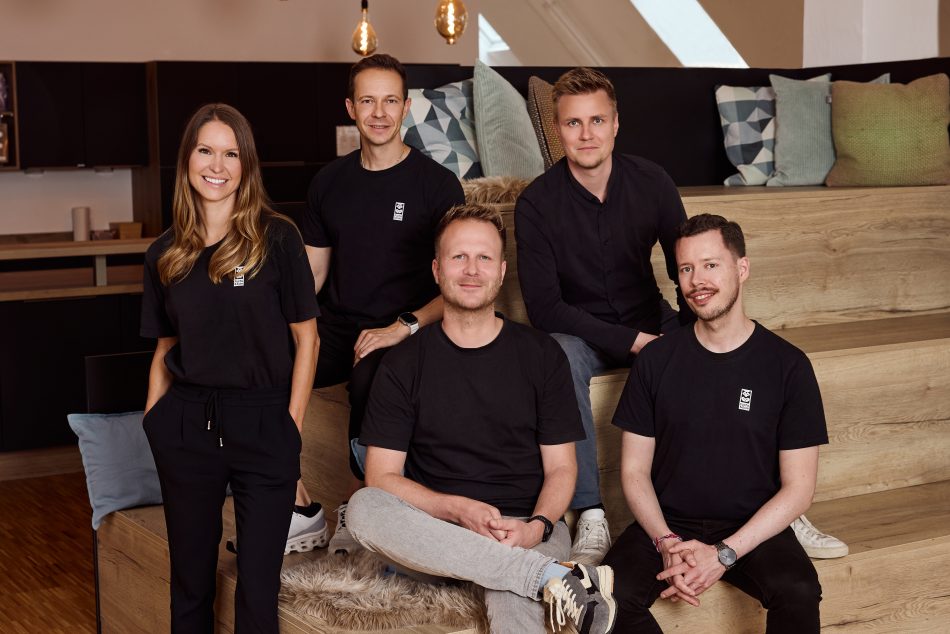
Fuchs & Eule provides a full-stack energy retrofit advisory service for institutional buildings owners, supporting the entire decision-making journey from initial portfolio assessment to execution and post-implementation monitoring.
Combining an in-house AI and workflow tech stack, a large proprietary database of real retrofit project data, and experienced energy consultants, it delivers trusted, reliable outcomes at scale.
Its target customers span the entire institutional real estate market, covering large asset managers, real estate funds, housing associations, property managers and corporate asset owners. It already serves over 270 customers, including some of the largest players in the German market. Every retrofit project adds over 10.000 data points to its database, meaning every customer improves its algorithm and, ultimately, product quality.
Why we believe Fuchs & Eule will win the B2B segment
What struck us from the first conversations with the team was their customer-first mindset. They understand the needs and operating conditions of their customers perfectly: institutional real estate managers need reliable retrofit measures that make sense, both financially and energetically. Rather than one-size-fits-all retrofit plans, customers receive bespoke measures that are tailored to the building condition, financing situation, and overall retrofit strategy. It is actionable, trustworthy output that customers can directly use to accelerate decision-making and implementation.
Those were compelling insights, but what really convinced us were the numbers. A significant, growing portion of revenue is already coming from existing customers making repeat purchases. Focusing on customers managing large portfolios with ongoing retrofit need means Fuchs & Eule can build strong customer relationships with long-term revenue potential. This sets a clear path towards profitable growth.
The team is also obsessed with boosting productivity via workflow automation and AI. Their north star KPI is Revenue per Energy Consultant per Hour, which captures their long-term vision perfectly: automating time-consuming tasks like calculations and filling in subsidy applications, so consultants can focus on high-margin advisory work. The team has built a number of in-house tech tools to track project status and performance while identifying workflows with the highest automation potential. Innovation, productivity, quality, and the optimal capital allocation from a financial and energetic point of view are Fuchs & Eule’s core DNA.
How Fuchs & Eule fits GET Fund
We have been tracking the retrofit landscape for quite some time and developed strong investment hypotheses around it. Our key assumption?
The low retrofit activity is not a demand issue, but a supply, coordination and technology problem clustered around three layers: planning, organization and physical execution.
Fuchs & Eule serves the planning layer, delivering intelligence that determines what gets renovated, in which sequence, and with what economic justification. As such, it complements the investments we made in the organisation and physical execution layers: VARM operates tech-enabled services (insulation) with a franchise model while Vamo scales execution (heat pump installation) with an operational platform and a piece of hardware simplifying installation.
They all own distinctive positions in the value chain and connecting them has the potential to create a shared data layer across planning, coordination and execution, compounding defensibility in a way no single-point solution can replicate.
Back to Insights